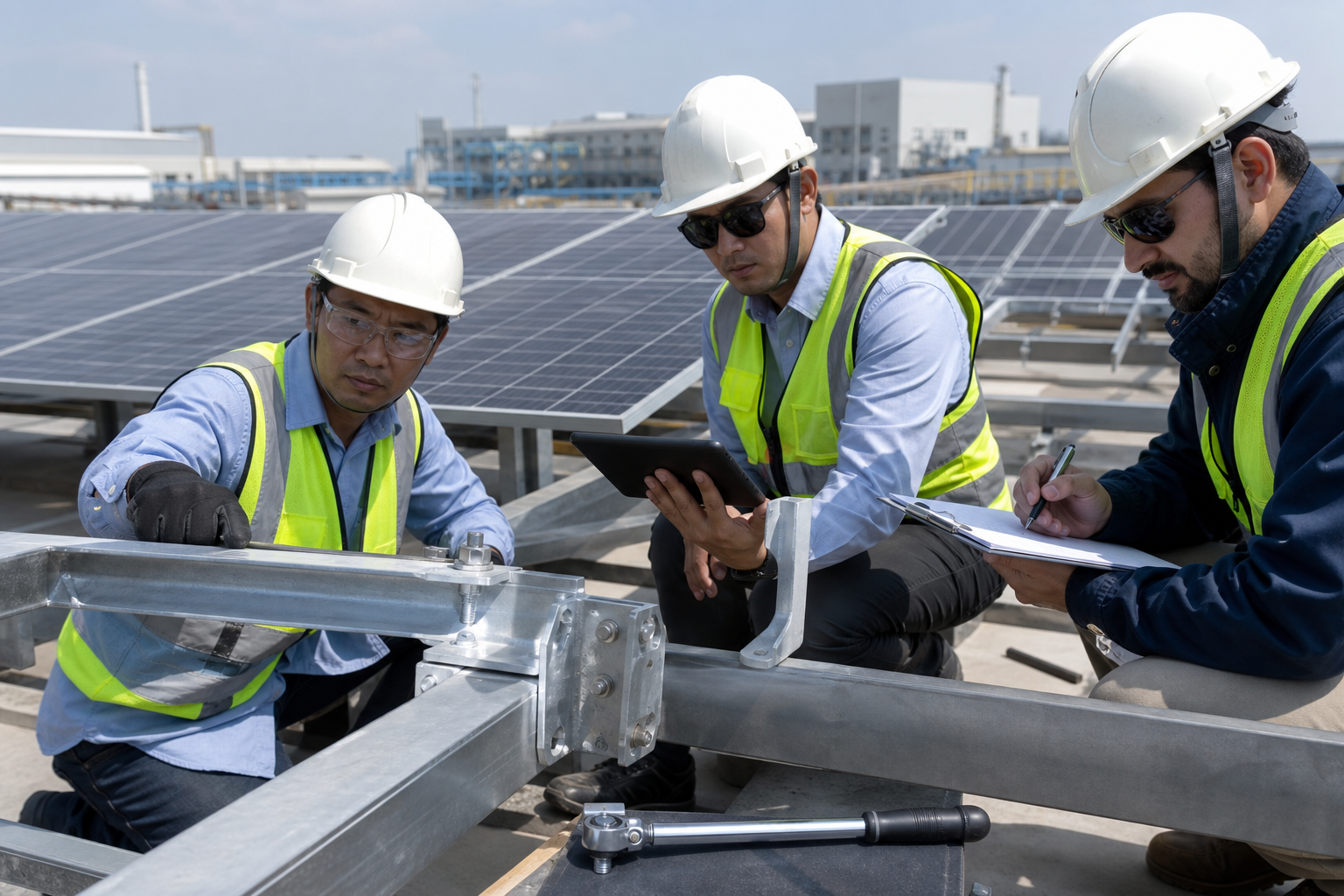
Choosing a solar panel mounting system should be simple on paper: compare material grade, wind load, coating, and price, then place the order. In practice, many EPC teams and sourcing managers discover that the real risk starts after the datasheet review. A solar mounting system can look competitive in a quotation stage yet create delays, redesign work, installation friction, certification questions, or long-term liability once the solar system project moves into execution.
That is why experienced buyers increasingly look beyond unit price and headline specs. They want a structure that is bankable, buildable, traceable, and defensible under project pressure.
Why datasheet comparisons often fail professional buyers
A datasheet is useful, but it is not a decision framework.
Two suppliers may present what appears to be the same solar panel mounting system: similar aluminum alloy, similar fasteners, similar corrosion claims, similar span values. Yet the project outcome can still be very different. The reason is simple: project success depends on what sits behind the numbers.
Professional buyers usually are not trying to buy metal alone. They are trying to reduce:
- design ambiguity
- compliance risk
- installation delays
- field modification costs
- warranty disputes
- cross-border sourcing uncertainty
- reputational damage if the solar system underperforms structurally
For EPCs, distributors, and project owners, the hidden cost is rarely the invoice line item. It is the downstream cost of a mounting choice that looked acceptable during tendering but becomes hard to defend during engineering review, authority approval, or site installation.
A better question is not just, “Which supplier is cheaper?” It is, “Which supplier helps us finish the project with fewer structural unknowns and less commercial exposure?”
What matters beyond the datasheet
When evaluating a solar mounting system, the strongest buying decisions usually come from four deeper checks:
- Certification credibility
- Load calculation methodology
- System-to-project fit
- Execution readiness across design, supply, and after-sales
These factors shape whether the mounting package will support a smoother solar system project or become another coordination problem between procurement, engineering, and site teams.
[Image suggestion: Procurement and engineering team reviewing solar mounting drawings and load tables in a meeting room. Alt text: “EPC team evaluating solar panel mounting system certification and structural load calculations”]
Certification: what buyers should verify, not just request
Certification is often treated as a box to tick. That is risky.
A supplier may state that its solar panel mounting system is “tested” or “compliant,” but sourcing teams should ask a more practical question: compliant to what, for which use case, and supported by which documents?
Depending on project location and application, relevant certification and documentation can include:
- material test reports
- corrosion resistance documentation
- fastener quality records
- structural calculation reports
- factory quality management documentation
- installation manuals and engineering drawings
- project-specific compliance support if required by local authority or client
The key is not collecting the maximum number of certificates. The key is verifying that the documentation is relevant to the actual project conditions.
Common certification misunderstandings
A frequent sourcing mistake is assuming that one generic certificate automatically validates every use case across roof, ground, carport, or agricultural applications. It does not.
A solar mounting system for one environment may not be appropriate for another if the following differ:
- wind exposure category
- snow load requirement
- roof type and pull-out conditions
- coastal or high-corrosion setting
- seismic considerations
- local building code interpretation
- module dimensions and clamp zone requirements
What strong certification support looks like
A reliable supplier should be able to explain, in clear terms:
- what has been tested or calculated
- what assumptions were used
- where the system limits are
- what site inputs are required from the buyer
- which values are standard and which are project-specific
This matters because certification is not only about approval. It is also about accountability. When questions arise during submittals or site execution, vague compliance language does not protect the EPC team.
For broader technical reference on solar research, design practices, and system performance resources, buyers often consult the National Renewable Energy Laboratory (NREL).
Load calculation: the part that quietly decides project risk
If certification builds trust, load calculation builds structural confidence.
Many sourcing teams receive wind and snow load figures in a quotation and assume those values are enough. They are not enough unless the calculation basis is understood. The most important issue is whether the solar panel mounting system has been evaluated for the actual project conditions, not just a generic catalog scenario.
Direct answer: Load calculation matters because the same mounting hardware can perform very differently depending on terrain, building height, module layout, tilt angle, span, and local code requirements.
What buyers should ask about load calculations
Ask the supplier or engineering team:
- Which code or calculation standard was used?
- Is the value based on a standard configuration or the actual project layout?
- What site data is required from us?
- Are uplift, sliding, and local connection loads addressed?
- What assumptions were made for roof substrate or foundation conditions?
- Are rail spans and clamp zones matched to module manufacturer limits?
- Is there a clear engineering output we can submit or review?
These questions help separate a commodity quote from a project-ready offer.
H3: Why generic wind load numbers can mislead
A quoted wind resistance value without context can create false confidence.
For example, if a supplier states a maximum wind load of [TO CONFIRM], that figure may depend on very specific assumptions about module size, row spacing, building height, edge zone treatment, fastener spacing, and attachment conditions. If your actual solar system project differs from those assumptions, the quoted figure may not apply in a meaningful way.
This is where many teams lose time. Procurement believes the structure is covered. Engineering later finds that the original values are not directly usable. The result is redesign, back-and-forth clarification, or worse, material replacement.
A trustworthy supplier helps buyers understand the calculation boundary before the PO is issued.
The real buying question: will this system reduce execution friction?
A solar mounting system should not only meet structural requirements. It should also support efficient execution.
For EPCs and sourcing teams, execution friction appears in predictable ways:
- too many unique components
- unclear bolt schedules or torque guidance
- packaging that slows site sorting
- poor part labeling
- missing installation sequence logic
- no adaptation path for non-standard roof conditions
- long response time for technical clarification
These issues rarely show up in a datasheet, but they strongly affect labor productivity and project predictability.
In other words, the buyer is not only purchasing a structure. The buyer is purchasing a level of coordination quality.
This is one reason many professional teams review both the supplier’s solar mounting system product range and its project-specific solar mounting solutions before making a sourcing decision. The goal is not to see more SKUs. The goal is to understand whether the supplier can map a system to real project constraints.
[Image suggestion: Rooftop solar installation with clearly organized mounting components and labeled rails. Alt text: “Organized solar mounting system components improving installation efficiency on a commercial rooftop”]
How to evaluate system-to-project fit
Not every solar system requires the same structural strategy. Fit depends on application.
A practical review should include:
Roof type and attachment logic
Metal roof, tile roof, flat concrete roof, and membrane roof systems each create different attachment and waterproofing considerations. The right solar panel mounting system needs to align with substrate behavior, not just panel layout.
Ground conditions and civil coordination
For ground-mount applications, the mounting supplier’s assumptions must align with geotechnical reality, foundation method, and civil tolerances. Misalignment here can create costly field adaptation.
Module compatibility
Clamp zones, frame dimensions, thickness ranges, and module orientation all affect whether the solar mounting system is truly compatible with the selected module family.
Corrosion environment
Coastal, industrial, high-humidity, or agricultural settings may require closer scrutiny of coating systems, fastener selection, and galvanic compatibility.
Installation method and labor profile
A system that looks efficient in engineering drawings may be less efficient for the actual crew, site access, or installation timeline. This is especially relevant when labor cost and project sequencing are tight.
Reverse-selling insight: why repeated supplier comparisons still lead to poor outcomes
Many teams assume better procurement comes from comparing more suppliers for longer. Sometimes the opposite is true.
When buyers repeatedly compare price sheets and headline specs without tightening the evaluation criteria, they often create the illusion of control while leaving the real risks untouched. The spreadsheet gets more detailed, but the decision does not get safer.
This happens because the unanswered questions remain the same:
- Can this supplier support project-specific calculations?
- Are the documents submittal-ready?
- Will site installation be straightforward?
- What happens if design assumptions change?
- Is technical support responsive after order placement?
The result is a stalled buying process followed by a rushed final decision.
A more mature procurement approach is to compare fewer variables, but compare the right ones: documentation quality, engineering responsiveness, calculation clarity, adaptability, and execution support.
That is how sourcing teams protect margin, schedule, and internal credibility.
A practical checklist for EPC and sourcing teams
Use this short-list before finalizing a solar panel mounting system supplier:
Technical due diligence
- Confirm application type: roof, ground, carport, or other
- Verify project wind, snow, and seismic requirements
- Review calculation basis and assumptions
- Check module compatibility and clamp zones
- Confirm corrosion suitability for site conditions
Documentation review
- Request relevant certification and quality documents
- Review engineering drawings and installation manuals
- Check whether material traceability is available if required
- Verify what is standard documentation versus project-specific output
Commercial and operational review
- Confirm lead time and packaging method
- Understand part coding and labeling
- Clarify technical response time during project execution
- Align on warranty scope and claim process
- Review change-management support if project conditions shift
This checklist is often more valuable than another round of basic price negotiation.
What confident buyers ultimately want
Most professional buyers are not looking for the cheapest structure in the solar system. They are looking for a decision they can defend.
They want to know:
- the system is structurally rational
- the documentation will stand up in review
- the supplier understands project pressure
- the installation team will not be forced into improvisation
- the commercial risk is contained
That confidence is especially important in a solar system project where multiple trades, deadlines, and approvals intersect. A mounting issue can cascade into schedule loss, labor inefficiency, and client frustration. A well-matched solar mounting system, by contrast, helps the whole project feel more controlled.
[Image suggestion: Completed commercial solar array with neat mounting alignment and clean structural detailing. Alt text: “Completed solar panel mounting system delivering a clean and reliable commercial installation”]
FAQ: Solar mounting system questions buyers often ask
Is certification enough to approve a solar panel mounting system?
No. Certification is important, but it does not replace project-specific engineering review. Buyers should confirm that the documentation matches the actual site conditions, loads, and application type.
Why is load calculation more important than a high headline load rating?
Because a high load rating without assumptions can be misleading. Real performance depends on module size, span, attachment conditions, terrain, roof zones, and local code inputs. Project-specific calculations are more useful than generic numbers.
What is the biggest procurement mistake in a solar system project?
A common mistake is choosing only on unit price or catalog specifications. This can overlook execution risk, documentation gaps, and engineering limitations that later increase total project cost.
How can EPC teams compare solar mounting suppliers more effectively?
Compare documentation quality, calculation transparency, module compatibility, installation practicality, and post-order technical support. These factors often predict project success better than minor price differences.
Should sourcing teams review product range or project solution capability first?
Both matter. A broad product range helps, but project solution capability is what shows whether the supplier can adapt the system to real site and engineering conditions.
Conclusion
A solar panel mounting system should do more than hold modules in place. It should reduce uncertainty for engineering, procurement, installation, and long-term asset performance.
For EPC and sourcing teams, the strongest decision is rarely the one with the shortest datasheet comparison. It is the one backed by relevant certification, clear load calculation logic, and supplier support that fits the realities of project delivery.
If you are reviewing options for an upcoming project, explore MagiSolor’s solar mounting system products and project solution capabilities to assess fit from both a technical and execution perspective. The right choice is not just about structure. It is about fewer unknowns, smoother delivery, and a decision your team can stand behind.