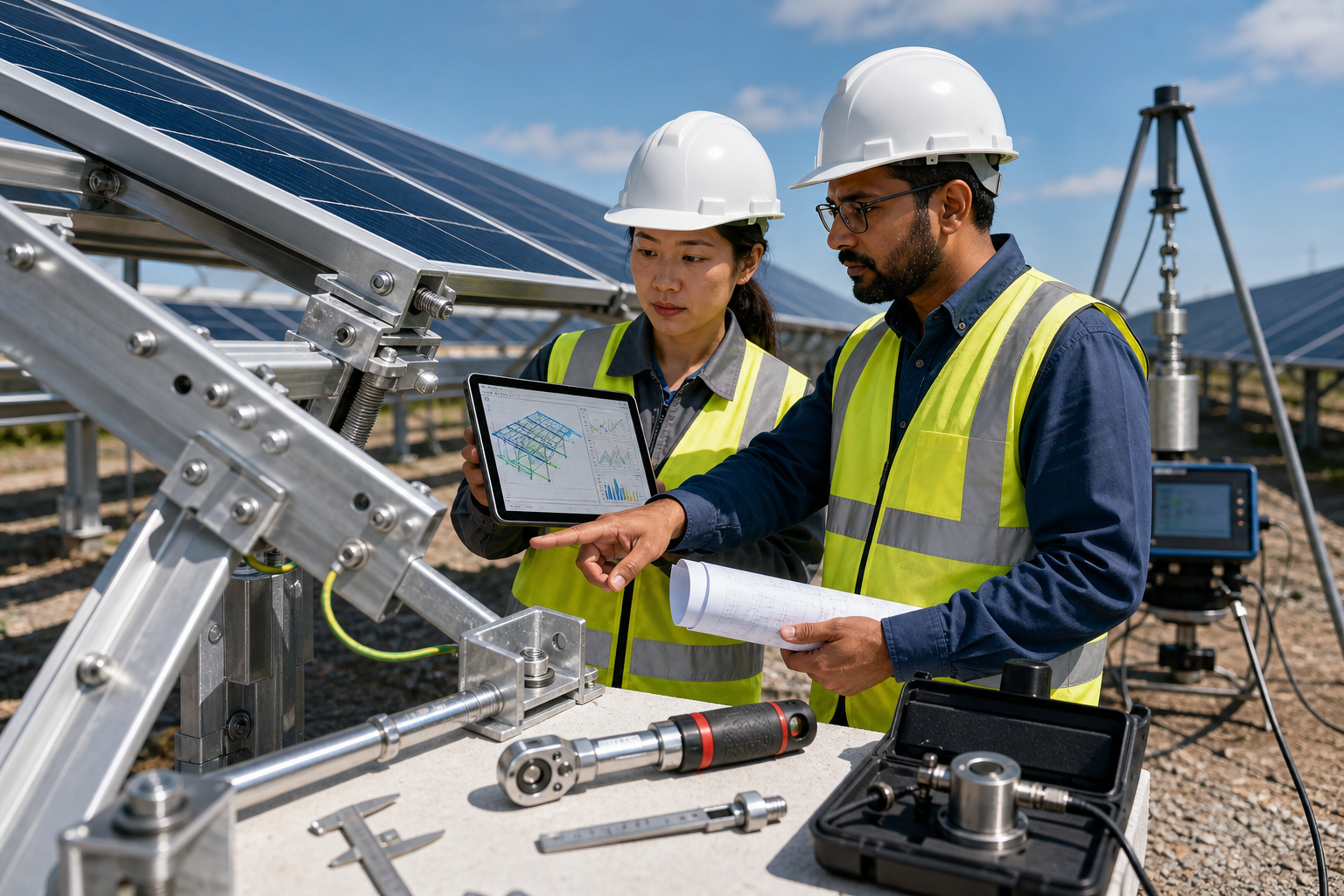
Choosing a solar panel mounting system manufacturer is not only a price decision. For EPC contractors, developers, and sourcing teams, the mounting structure directly affects project safety, installation speed, long-term reliability, and bankability. A weak supplier review process can create delays in approvals, redesign work, logistics issues, or even structural risk in service. This checklist focuses on two areas that matter most during procurement: certification and load calculation, while also covering quality control, material traceability, and delivery capability for a modern solar mounting system supply chain.
For buyers managing a utility, commercial, or distributed solar system project, the goal is simple: confirm that the manufacturer can supply a compliant, durable, and installable structure for the real site conditions.
Why manufacturer evaluation matters in solar mounting procurement
A solar mounting structure is often treated as a standard balance-of-system item. In practice, it is a structural product that must perform for decades under wind, snow, thermal expansion, corrosion exposure, and installation tolerances.
If the supplier lacks engineering depth, the cost of that gap usually appears later through:
- Design revisions after permit review
- Mismatch between drawings and delivered components
- Excessive steel or aluminum consumption
- On-site installation inefficiencies
- Unclear warranty accountability
- Higher O&M risk over the project lifecycle
For EPC and sourcing teams, a disciplined prequalification process improves both technical confidence and procurement efficiency. It also helps align engineering, purchasing, QA, and project management before orders are placed.
[Image suggestion: Procurement manager reviewing PV mounting drawings and certification files with engineering team. Alt text: “EPC team evaluating solar panel mounting system certification and structural documents”]
The core checklist: what to verify before selecting a manufacturer
Below is a practical checklist for comparing suppliers of a solar panel mounting system. It can be used in RFQ reviews, technical clarification rounds, and final vendor selection.
1. Product certification and compliance documents
Start with document control. A credible manufacturer should be able to provide a complete and current compliance package, not just a marketing brochure.
Check for:
- Product test reports relevant to the mounting structure
- Material certificates for steel, aluminum, and fasteners
- Coating or anodizing specifications
- Factory quality management certifications such as ISO 9001
- Traceability procedures for incoming raw materials and finished goods
- Regional compliance support for local code requirements
For many buyers, certification is not about collecting logos. It is about verifying that the supplier has a repeatable process for quality and structural validation. Ask whether the test conditions match your application, including roof type, ground foundation assumptions, module dimensions, and environmental exposure.
If your procurement team is still comparing system categories, review MagiSolor’s solar panel mounting system products to understand common structure types and design options.
Certification review: what EPC teams should ask
Certification review should go beyond “Do you have certificates?” The better question is: Which certifications and test reports are applicable to this exact project configuration?
Ask the manufacturer to clarify:
- Which documents apply to rooftop systems versus ground-mount systems
- Whether calculations are project-specific or based on a generic catalog design
- The design standard used for structural checks
- Whether connection details and fastener performance are included in validation
- How updates are managed when module size, tilt angle, or site wind speed changes
A reliable supplier should be comfortable explaining the difference between standard product qualification and project engineering verification. That distinction matters when the solar system moves from concept to permitting and construction.
H3: Red flags in certification packages
Watch for these common issues:
- Expired certificates or reports with no revision control
- Test reports that do not match the offered system geometry
- Missing material grade information
- Generic statements like “designed to international standards” without naming the standard
- No clarity on who stamped or reviewed the structural calculations
These gaps do not always mean the supplier is unqualified, but they do signal the need for deeper technical review before award.
Load calculation: the most important engineering checkpoint
Load calculation is often the deciding factor in whether a mounting system is truly fit for purpose. A low initial quote can become expensive if the structure is underdesigned, overdesigned, or not adapted to actual site loads.
At a minimum, ask the manufacturer to show how the solar panel mounting system is evaluated for:
- Wind load
- Snow load
- Dead load
- Seismic conditions, where required
- Thermal movement
- Uplift at edges and corners
- Foundation or roof attachment loads
For rooftop projects, review not only the frame but also the interface with the building. For ground-mount projects, verify assumptions for soil conditions, pile depth, concrete foundations, and allowable deflection.
A credible load calculation package should clearly state:
- Site design criteria
- Applicable building or structural standard
- Module layout assumptions
- Rail span assumptions
- Clamp zones and module support points
- Safety factors
- Maximum allowable loads and deflection limits
This is where sourcing teams should involve engineering early. Procurement can compare price, but engineering must confirm that two offers are actually equivalent.
[Image suggestion: Structural engineer checking wind and snow load calculations for a solar mounting system. Alt text: “Load calculation review for a solar mounting system in an EPC procurement process”]
How to assess load calculations with confidence
A good review process is straightforward. Ask the manufacturer to submit a calculation package and compare it against project inputs from the EPC design team.
Key questions include:
- Are the site conditions project-specific?
Wind speed, terrain category, snow load, and seismic data should match the site.
- Are the structural assumptions realistic?
Rail spacing, post spacing, clamp positions, and support conditions should reflect the actual design.
- Is the design optimized or simply conservative?
Overdesign increases material cost and shipping weight. Undesign increases risk.
- Are attachment points verified?
Roof anchors, piles, or concrete interfaces must be part of the structural logic.
- Is there clear accountability?
You should know whether the calculations come from the manufacturer’s engineering team, a third-party engineer, or a local design partner.
For technical context on PV system design and performance research, teams can also refer to the U.S. National Renewable Energy Laboratory at NREL.
Material quality, corrosion resistance, and durability
Certification and calculations are central, but material quality is what turns a design into a long-life asset. Ask about:
- Steel grade and source
- Aluminum alloy and temper
- Fastener material and anti-corrosion treatment
- Galvanization thickness or anodizing specification
- Compatibility between dissimilar metals
- Salt mist or corrosive environment suitability for coastal sites
- Warranty scope and exclusions
A dependable manufacturer should explain how the mounting system is adapted for inland, humid, industrial, or coastal conditions. This is especially important for projects expected to operate 25 years or more.
In practical terms, the lowest-cost structure is not always the lowest lifecycle-cost structure. Corrosion failures, seized fasteners, and coating inconsistency can turn a modest saving into an expensive field issue.
Manufacturing capability and supply chain reliability
For EPC and sourcing teams, technical approval is only half the job. The supplier must also deliver at the required scale and timeline.
Review these factors:
- Factory production capacity
- In-house versus outsourced processes
- Lead times for standard and custom components
- Packaging method for export shipments
- Container loading efficiency
- ERP or order tracking discipline
- Spare parts support
- Ability to provide pre-assembly where needed
Ask for photos, process flow charts, and sample packing lists. A mature manufacturer should show consistency from drawing release to final shipment.
If your team is evaluating project fit by application, explore MagiSolor’s solar mounting system solutions for rooftop, ground, and tailored deployment scenarios.
Documentation support for EPC workflow
A strong supplier reduces friction by providing complete project documentation in a format the EPC team can use immediately.
Preferred deliverables include:
- GA drawings
- Bill of materials
- Installation manuals
- Structural calculation reports
- Foundation load reactions
- Material certificates
- Packing lists
- Labeling or pallet identification details
For larger projects, ask whether the manufacturer can support staged deliveries, version control, and document turnover by lot or section.
This matters because a solar system project often involves multiple handoffs between design, procurement, logistics, and field installation. A technically good supplier can still create delays if documentation is incomplete or poorly controlled.
Practical questions for vendor comparison
When issuing RFQs or conducting technical clarification, use questions that reveal engineering depth and execution maturity.
Examples:
- Can you provide project-specific load calculations based on our site parameters?
- Which standards are used for structural design and verification?
- What corrosion protection options are available for coastal or high-humidity sites?
- Can the system accommodate different module sizes without major redesign?
- What is your tolerance control for rails, clamps, and post alignment?
- How do you handle design revisions after initial quotation?
- What are your standard warranty terms for structure and coating?
- Can you provide references for similar climates or similar MW scale?
These questions are far more useful than asking only for the lowest unit price.
A simple evaluation scorecard for sourcing teams
To make supplier comparison objective, assign weighted scores across five areas:
| Evaluation Area | Suggested Weight | |—|—:| | Certification and compliance | 25% | | Load calculation and engineering support | 30% | | Material quality and corrosion resistance | 20% | | Manufacturing and delivery capability | 15% | | Documentation and after-sales support | 10% |
This approach helps teams compare total procurement value instead of just ex-works pricing. It also makes internal approvals easier because the decision is tied to measurable criteria.
What a good manufacturer relationship looks like
The most effective supplier relationships are collaborative, not transactional. A good manufacturer will:
- Ask for site-specific inputs early
- Flag engineering risks before production
- Recommend value engineering where appropriate
- Support permitting and technical review
- Maintain document traceability
- Stay responsive through delivery and installation
That level of support is especially valuable when the solar system design evolves during project development. Module changes, layout adjustments, and code review comments are common. Suppliers that can adapt quickly reduce schedule risk.
FAQ
What certifications should a solar panel mounting system manufacturer provide?
At minimum, the manufacturer should provide relevant product test reports, material certificates, coating specifications, and quality management documentation such as ISO 9001. EPC teams should also verify that the documents apply to the exact project configuration, not only to a generic catalog product.
Why are load calculations so important for a solar mounting system?
Load calculations confirm whether the structure can safely resist wind, snow, dead load, uplift, and other site-specific forces. They also show whether the design is optimized. Without project-based calculations, a solar mounting system may be unsafe, overbuilt, or incompatible with local code requirements.
How can sourcing teams compare solar mounting system suppliers fairly?
Use a scorecard that weighs certification, engineering, material quality, manufacturing capability, and documentation support. This prevents decisions based only on unit price and helps confirm that suppliers are being compared on equivalent technical scope.
What should EPC teams check for rooftop solar system applications?
For rooftop applications, review structural calculations for both the mounting frame and the building interface. Attachment points, waterproofing details, ballast assumptions, roof load limits, and thermal movement should all be checked before procurement approval.
Does a lower mounting structure price usually mean better value?
Not necessarily. Lower price can reflect thinner materials, less corrosion protection, limited engineering support, or incomplete documentation. The better measure is total project value across safety, installability, durability, and delivery reliability.
[Image suggestion: Installed commercial solar panel mounting system on rooftop with organized rails and clamps. Alt text: “Commercial solar panel mounting system installed with certified structural design”]
Conclusion
A capable solar panel mounting system manufacturer should do more than supply metal parts. The right partner supports compliance, delivers clear load calculations, maintains material quality, and helps EPC teams reduce technical and schedule risk.
If you are evaluating suppliers for your next solar system project, start with certification, structural logic, and documentation discipline before comparing price. To review available products and application-specific options, visit MagiSolor’s product page or explore our solutions page.